As an Amazon Associate, I earn from qualifying purchases.
The best climbing plants for backyard garden fences include clematis, coral honeysuckle, climbing roses, passionflower, American wisteria, and native trumpet honeysuckle. Choose one that suits your USDA growing zone, sunlight, fence material, and desired level of coverage.
A plain backyard fence can make even a lovely garden feel a little dull. Across the United States, homeowners use climbing plants to soften wooden fences, add color to chain-link boundaries, and create green screens around patios and outdoor seating areas. A well-chosen vine can turn a simple fence into a living part of the landscape.
The right plant depends on where you live. A sunny backyard in Texas has different growing conditions from a shaded yard in Pennsylvania or a cool garden in Minnesota. Local rainfall, winter temperatures, soil, and the amount of summer heat all affect which vines will thrive.
Some climbing plants wrap their stems around a support, while others grip a trellis with tendrils or attach themselves to surfaces. This difference matters because not every vine can climb a solid wooden fence on its own. A little planning before planting can prevent damaged boards, tangled growth, and years of unwanted pruning.
This guide compares useful climbing plants for common American backyard conditions. It also explains how to match a vine to your fence, provide proper support, encourage even coverage, and avoid plants that may become invasive.
1. Clematis: Best for Colorful Flowers on Garden Fences
Clematis is one of the most versatile climbing plants for a backyard fence. Its flowers come in shades of purple, blue, pink, red, and white, depending on the species and cultivar. Some types produce large, showy flowers, while others have smaller blooms that appear in clusters.
Most clematis vines climb by using twisting leaf stalks. They need a narrow support, such as a wire, mesh panel, or trellis, rather than a wide, solid fence board. Once the young stems reach the support, they can wrap around it and grow upward.
Clematis can work in many American gardens, but the best variety depends on the local climate. Some types tolerate cold winters, while others prefer warmer regions. Check the plant label and local extension advice before choosing a variety.
Source: gardenguides.com
Best growing conditions
Many clematis varieties grow well in full sun or partial shade. Their roots generally benefit from cool, evenly moist soil and a layer of mulch.
Fence support
Use narrow wires, mesh, or a trellis that gives the leaf stalks something to grip. Guide new stems toward the support as they grow.
Maintenance
Pruning needs vary by clematis group. Identify the variety before cutting, since some flower on old growth and others bloom on new growth.
How to Get Even Clematis Coverage
Plant clematis where its roots can stay cool and moist while its upper growth receives enough light. Avoid letting the base dry out during hot summer weather. Spread mulch over the root area, but keep it slightly away from the main stem.
Fan the young stems across the lower part of the fence instead of allowing every branch to climb from one point. This helps the plant fill gaps and creates a more balanced display. Use soft plant ties when needed, and never pull stems tight against sharp wire.
Good choice for
Gardeners who want colorful seasonal flowers and can provide a fine support structure.
Main limitation
Some varieties need careful pruning and regular watering during dry spells.
2. Coral Honeysuckle: Best Native Vine for Hummingbirds
Coral honeysuckle, also called trumpet honeysuckle, is a strong option for American gardeners who want flowers and wildlife value. Its tubular blooms are often red or coral on the outside, with lighter shades inside. Hummingbirds visit the flowers for nectar, making this vine useful near a backyard bird garden.
Its botanical name is Lonicera sempervirens. It is native to parts of the eastern United States and can grow as a perennial vine in suitable climates. It generally performs well in full sun to partial shade, although flowering is often better with good sunlight.
Unlike a vine that sticks directly to a fence, coral honeysuckle uses twining stems. It needs a trellis, fence mesh, or a system of narrow horizontal wires. It can cover an open fence attractively when its stems are spread across the support.
Source: cdn.mos.cms.futurecdn.net
Flowers and wildlife
Its tubular flowers attract hummingbirds and other pollinators. Small berries may also provide food for birds.
Light needs
Full sun usually encourages better flowering, but partial shade can also work in many locations.
Water needs
Water young plants while they establish. Once established, watering needs depend on rainfall, soil, and regional heat.
Why Choose Native Honeysuckle Instead of Japanese Honeysuckle?
Not all honeysuckles have the same growth habits. Japanese honeysuckle, Lonicera japonica, is invasive in many parts of the United States and can spread beyond the space where it was planted. Coral honeysuckle is a better regional option where it is native and suited to the site.
Before buying a honeysuckle vine, check the botanical name on its label. A common name alone is not enough to identify the plant. Local native plant societies and university extension services can help confirm whether a selection is appropriate for your area.
Good choice for
Wildlife-friendly gardens, open fences, and gardeners who want a flowering native vine.
Main limitation
It needs a structure for twining and may need training to spread evenly across a fence.
3. Climbing Roses: Best for Classic Backyard Beauty
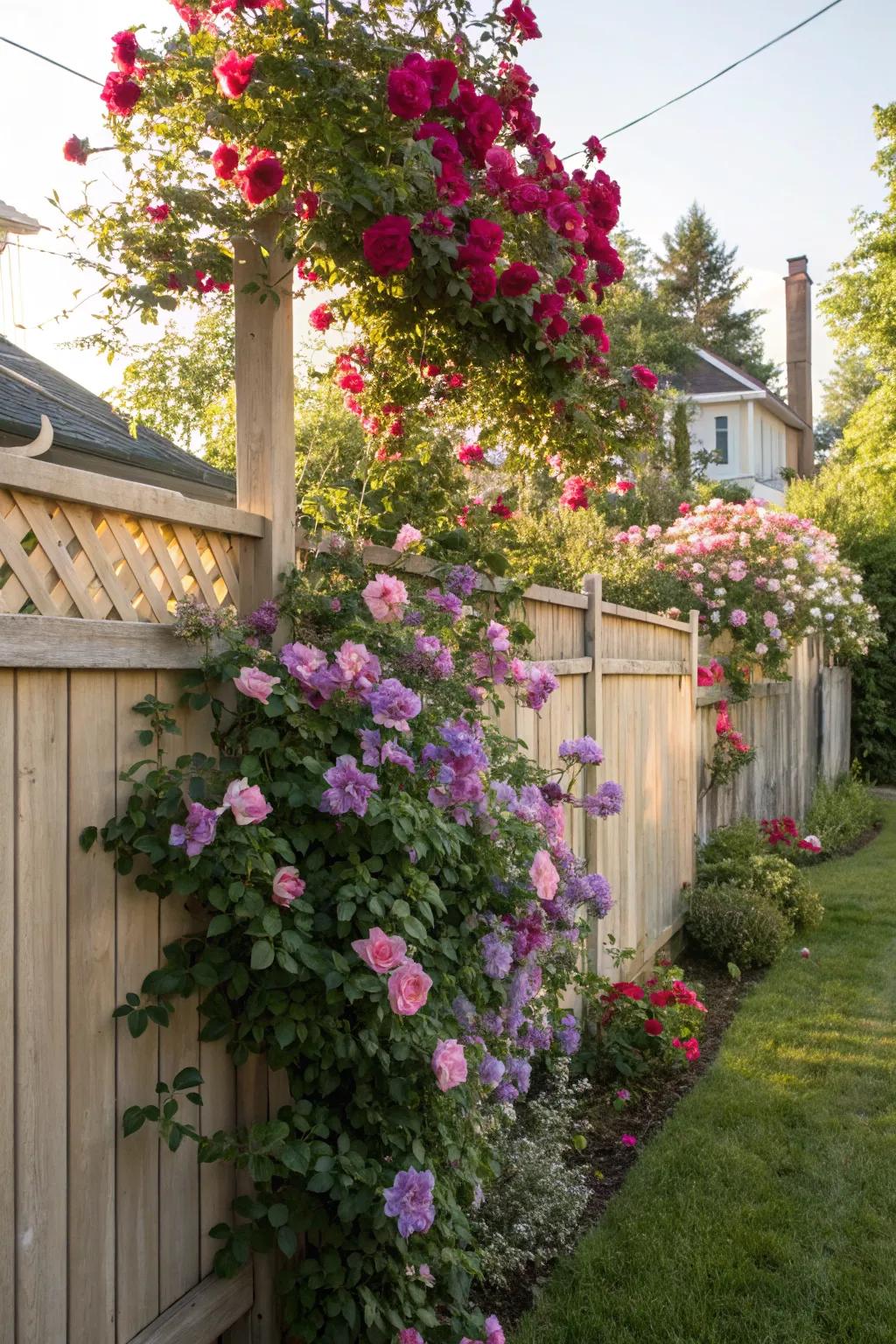
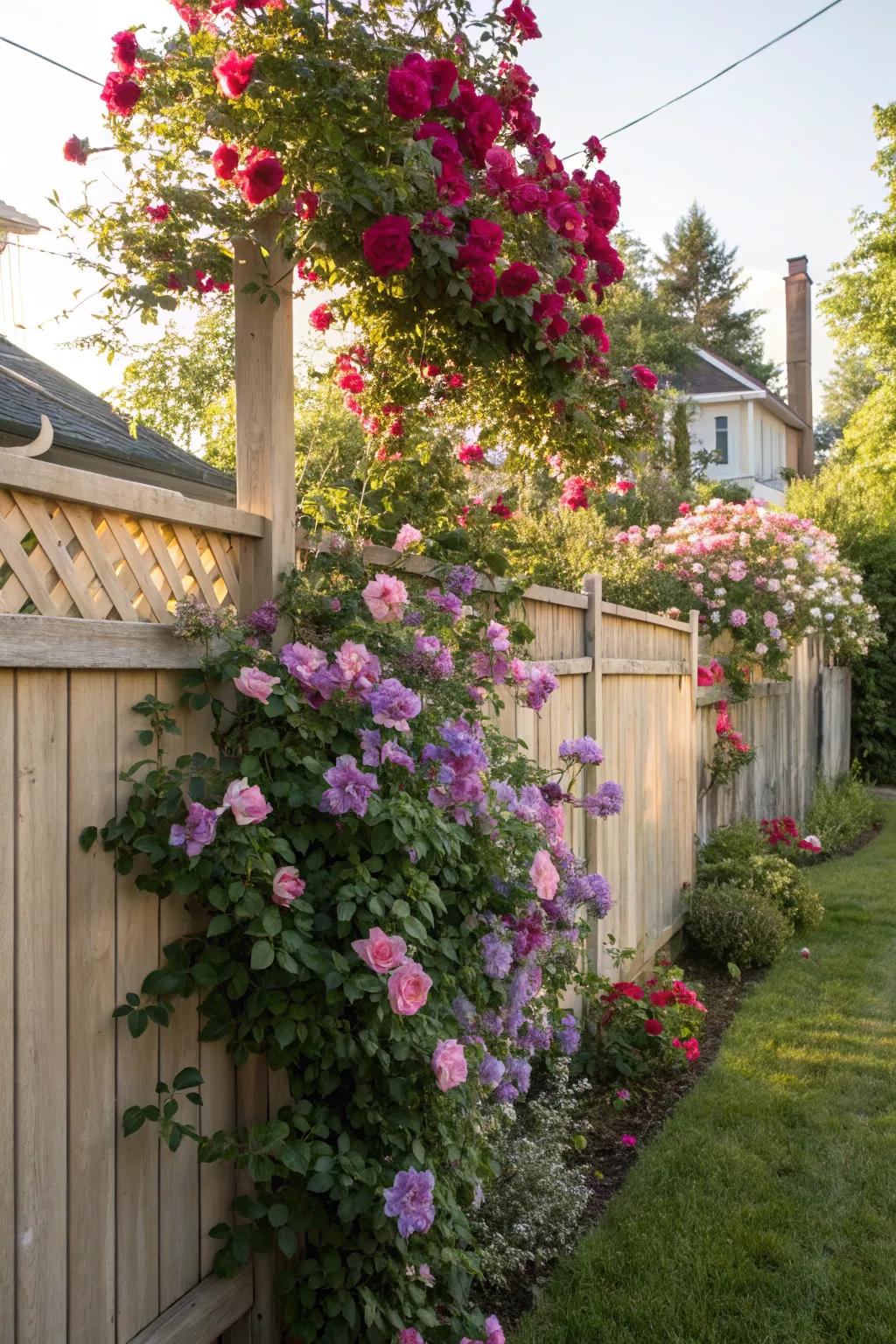
Climbing roses bring a classic garden look to a sunny backyard fence. Their long canes can carry clusters of flowers in pink, red, yellow, orange, and white. Depending on the variety, blooms may appear once during the growing season or return in several flushes.
Climbing roses do not naturally grip a fence. They produce long, flexible canes that must be tied to wires, a trellis, or another sturdy support. This gives gardeners more control over the direction of growth and makes it easier to arrange branches across a fence.
Most climbing roses prefer a site with several hours of direct sunlight and well-drained soil. Good air movement around the leaves can also help reduce some common fungal disease problems. Avoid crowding the rose between dense plants or against a poorly ventilated fence.
Source: i.pinimg.com
Best location
A sunny fence with enough open space for long canes and good air movement.
Support system
Install sturdy horizontal wires or a strong trellis before planting. Tie canes with soft, flexible garden ties.
Pruning
Remove dead or damaged growth and shape the plant according to its variety. Avoid cutting all long canes without checking its flowering habit.
Train Rose Canes for More Flowers
Rather than sending every cane straight up, guide suitable long canes outward and along the fence. A more horizontal position can encourage flowering side shoots along the length of the cane. Secure the stems loosely so they have room to thicken.
Choose a rose with a mature size that fits the fence. A large rambler can overwhelm a small garden panel, while a compact climbing rose may suit a short fence section. Disease resistance, fragrance, repeat flowering, and thorniness are also useful traits to compare.
Good choice for
Sunny backyards where flowers and a traditional garden style are the main goals.
Main limitation
Roses need tying, pruning, and attention to common pests and leaf diseases.
4. Passionflower: Best for Unusual Flowers and Tropical Appeal
Passionflower is a striking choice when you want a backyard fence to become a feature. Its flowers have a detailed, unusual shape, often with colorful rings and fine filaments around the center. Some species also produce edible fruit, although fruit production depends on the species, pollination, and climate.
Maypop, Passiflora incarnata, is a North American native passionflower found across parts of the eastern and southeastern United States. It produces showy flowers and may form edible fruit. It spreads through underground growth and can return from the roots in suitable areas, so allow enough room for it.
Passionflower climbs with tendrils that wrap around slender supports. A chain-link fence, wire grid, or narrow trellis is more useful than a solid wooden panel. Its growth may die back in colder climates, while the root system can survive and send up new growth where conditions permit.
Source: cdn.mos.cms.futurecdn.net
Sunlight
A sunny location usually supports strong growth and flowering. Some afternoon shade can help in very hot locations.
Support
Provide wire, mesh, or trellis openings that its tendrils can grasp.
Growth control
Watch for spreading shoots and guide the vine before it becomes tangled with nearby plants.
Is Passionflower Suitable for a Small Backyard?
It can be, provided you choose a suitable species and manage its spread. Maypop is a vigorous perennial in favorable conditions, so it may not be the best choice beside delicate flowers or a narrow garden bed. A large container can help restrict its roots, although the plant will still need a strong climbing support and regular watering.
Do not assume every passionflower is equally cold-hardy or suitable for eating. Confirm the botanical species before planting or using any fruit. Keep the vine away from areas where its growth could block gates, paths, or fence access.
Good choice for
Gardeners who want unusual flowers, pollinator interest, and a vigorous vine.
Main limitation
Some types spread strongly and may need space or root control.
5. American Wisteria: Best for Fragrant Flower Clusters
American wisteria, Wisteria frutescens, produces hanging clusters of flowers that can give a backyard fence a soft, elegant look. The blooms are commonly purple or lavender, and some cultivars offer repeat flowering under suitable conditions. Its scent and flower display make it appealing near patios and garden seating areas.
American wisteria is native to parts of the southeastern United States. It is generally a more restrained choice than the highly vigorous Asian wisterias, but it is still a woody vine that needs firm support and regular pruning. A lightweight decorative fence is not a suitable structure for a mature plant.
Wisteria climbs by twining its stems around supports. Use a strong trellis or a separate framework with durable posts and wires. Keep the mature weight of the vine in mind before planting, especially if the fence is old or already leaning.
Source: i.pinimg.com
Best conditions
A sunny location with well-drained soil generally supports better flowering.
Structural needs
Use a sturdy support designed for a mature woody vine rather than relying on thin fence boards.
Pruning
Regular pruning helps control long shoots and maintain the intended shape.
Choose American Wisteria With Care
The name wisteria covers several species, and they do not all have the same growth habits. Japanese wisteria and Chinese wisteria can become extremely vigorous and are invasive in some parts of the United States. American wisteria is the more suitable native option in many southeastern landscapes.
Check the exact botanical name before purchasing. Also remember that wisteria seeds and other plant parts should not be eaten. Keep the vine away from areas where children or pets may chew on plant material, and ask a local extension service about regional concerns.
Good choice for
Large backyards with strong supports and gardeners who can prune woody vines.
Main limitation
Its mature size and weight make it unsuitable for weak or lightweight fences.
6. Virginia Creeper: Best for Fast Foliage and Fall Color
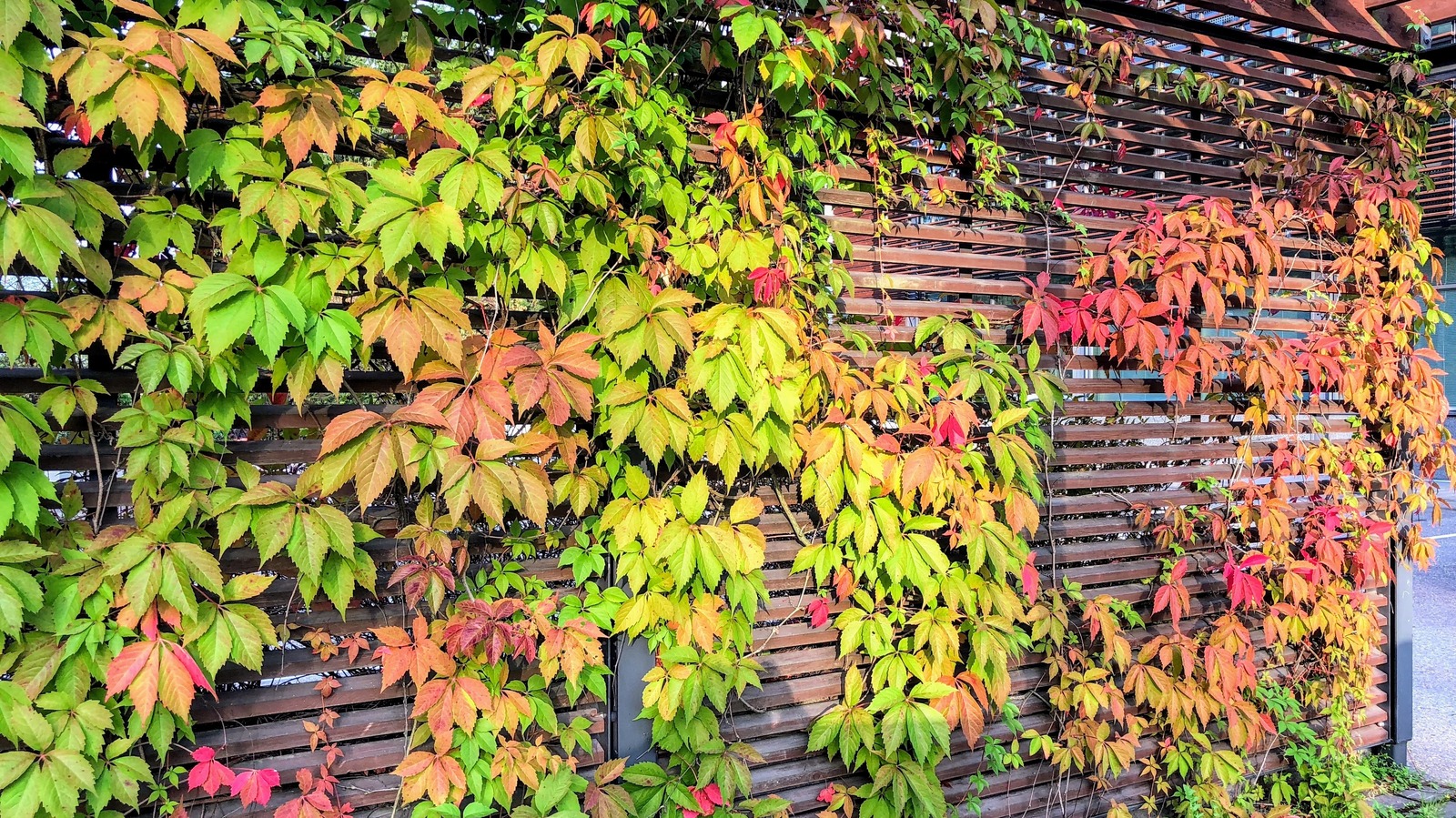
Virginia creeper, Parthenocissus quinquefolia, is a vigorous native vine known for its five-part leaves and brilliant fall color. In summer, its green foliage can cover a large section of a fence. In autumn, the leaves often turn shades of red and purple, adding seasonal interest.
This vine climbs using small adhesive pads at the ends of tendrils. Those pads help it attach to surfaces, but they can leave marks and may be difficult to remove. Virginia creeper is therefore better suited to a separate trellis or a suitable masonry surface than a delicate wooden fence.
Virginia creeper tolerates a range of conditions, including sun and partial shade. It can become very large, however, and its growth needs regular control. Keep it away from gutters, roof edges, small shrubs, and trees that it could cover.
Source: cdn.mos.cms.futurecdn.net
Foliage
Dense green summer leaves and strong red or purple fall color.
Climbing method
Adhesive pads attach to surfaces, so a removable trellis can make future maintenance easier.
Maintenance
Cut back unwanted shoots and prevent the vine from spreading into neighboring plants or structures.
A Safety Note About Virginia Creeper
Virginia creeper is not the same plant as poison ivy, but its berries and leaves should not be eaten. The sap and plant material may also irritate some people. Wear gloves and long sleeves when cutting or removing large amounts of growth.
Birds may eat its berries, but that does not make the fruit safe for people. If you have young children or pets, consider the location of the vine and whether they can reach its fruit.
Good choice for
Large fences where dense foliage and autumn color are welcome.
Main limitation
Its adhesive pads and vigorous growth can make removal and control difficult.
7. Black-Eyed Susan Vine: Best Annual Climber for Seasonal Color
Black-eyed Susan vine, Thunbergia alata, is a useful annual climber for gardeners who want a quick display of flowers without committing to a large woody perennial. Its cheerful flowers often have yellow, orange, or white petals with a dark center. It can bring a bright look to a small fence, patio screen, or garden trellis.
This vine climbs by twining around narrow supports. It works well on wire grids, garden mesh, and small trellises. Because it is usually grown as an annual in much of the United States, it is a practical option for gardeners who like changing their fence display from year to year.
Black-eyed Susan vine prefers warm weather and a sunny or partly shaded site. Water it during dry periods, and give it enough space to branch. In warm regions, check local guidance about whether it can persist or spread beyond the planting area.
Source: i.pinimg.com
Flower display
Bright, often dark-centered flowers that can continue through much of the warm growing season.
Growing habit
A twining vine that needs a narrow support rather than a solid fence surface.
Seasonal use
Useful for temporary coverage while slower perennial vines become established.
Pair Annual Vines With Permanent Fence Plants
An annual climber can add flowers during the first season while a slower perennial vine is still growing. For example, a small black-eyed Susan vine can cover part of a trellis beside a young clematis. Keep enough room between the plants to prevent competition for light and water.
Do not let the annual vine smother a young perennial. Remove excess stems when they begin to tangle, and clear dead growth at the end of the season.
Good choice for
Small gardens, seasonal color, containers, and gardeners who enjoy changing plants each year.
Main limitation
It does not provide dependable year-round privacy and may need replanting each season.
How to Choose the Right Climbing Plant for Your Fence
The best fence vine is not always the fastest-growing or the one with the biggest flowers. It is the plant that fits the fence, climate, available light, and amount of care you can provide. Start by checking the fence itself, then compare plants that suit the site.
A useful way to make the decision is to separate the goal from the growing conditions. A gardener who wants privacy needs a different type of foliage from someone who wants a few flowers along a decorative fence. A shaded fence also needs a different plant from a hot fence that receives direct afternoon sun.
The following comparison summarizes the main choices in this guide. Mature size, flowering, and winter behavior can vary by species and cultivar, so use local plant labels and extension guidance to confirm the details before buying.
Source: guterboden.de
For flowers
Choose clematis, climbing roses, coral honeysuckle, or American wisteria, depending on sunlight and support.
For wildlife
Consider native coral honeysuckle or native passionflower where each species is suitable for the region.
For fall color
Virginia creeper offers seasonal foliage color, but it needs room and careful control.
For temporary coverage
Black-eyed Susan vine can provide warm-season flowers while a perennial climber establishes.
Compare the Main Fence Climbers
Use this table as a starting point rather than a universal ranking. It compares each plant’s main garden value, climbing method, and the type of fence support it needs.
Clematis
Best for varied flower colors; climbs by twisting leaf stalks; needs fine wires, mesh, or trellis.
Coral honeysuckle
Best for native wildlife value; climbs by twining; needs narrow wires or a trellis.
Climbing roses
Best for classic flower displays; sprawling canes do not cling; needs tying to a strong support.
Passionflower
Best for unusual flowers; climbs with tendrils; needs wire or mesh.
American wisteria
Best for fragrant flower clusters; climbs by twining; needs a very sturdy support.
Virginia creeper
Best for dense foliage and fall color; uses adhesive pads; needs a surface that can tolerate attachment or a separate support.
Black-eyed Susan vine
Best for seasonal flowers; climbs by twining; needs narrow trellis sections or garden mesh.
Match the Plant to Sunlight
Observe the fence at different times of day before choosing a vine. A fence that receives direct sun for much of the afternoon can become hot and dry, especially beside a paved patio. A fence under mature trees may receive filtered light and have strong root competition.
Full-sun plants generally need at least six hours of direct sunlight, although exact needs vary by species. Partial-shade plants may perform well with less direct sun. For a deeply shaded fence, do not expect a sun-loving vine to flower well just because its leaves survive.
Sunny fences
Consider suitable clematis varieties, climbing roses, coral honeysuckle, and American wisteria.
Partly shaded fences
Look at shade-tolerant clematis varieties and coral honeysuckle, while checking local cultivar requirements.
Deep shade
Choose a plant specifically rated for low light rather than forcing a flowering sun-loving vine to grow in poor conditions.
Check Your USDA Hardiness Zone
The USDA Plant Hardiness Zone Map helps gardeners compare average annual extreme minimum winter temperatures. It is useful when deciding whether a perennial vine can survive local winters, but it does not measure summer heat, rainfall, soil drainage, or the length of the growing season.
Check the plant’s hardiness range and compare it with your location. A vine may survive winter in your zone but still struggle with humid summers, drought, or poor drainage. Regional university extension services can help you narrow the choice.
Cold regions
Look for cold-hardy species and protect young plants from severe winter exposure when needed.
Hot regions
Choose vines that tolerate local summer heat and provide water while plants establish.
Coastal or humid areas
Consider disease pressure, salt exposure, drainage, and the local performance of each cultivar.
How to Prepare a Backyard Fence for Climbing Plants
A good support system helps a climbing plant grow in the right direction and protects the fence from unnecessary strain. Before planting, check whether the fence posts are firm, the boards are sound, and the structure can handle the mature plant. A heavy woody vine should not be placed on a weak or damaged fence.
Many twining and tendril-based vines cannot climb broad, smooth boards. They need thin wires, mesh, or a trellis with openings that the stems can reach. A removable support also makes it easier to paint, repair, or replace fence boards later.
For wooden fences, keep dense foliage from sitting tightly against the boards. Moisture can remain trapped behind thick growth, which may speed up decay. A support that allows air to move between the vine and fence is a practical choice.
Source: i.ytimg.com
Inspect the fence
Look for loose posts, cracked boards, rusted fasteners, and signs of rot before adding a plant.
Install supports first
Attach suitable trellis panels or coated wires before planting so roots and young stems are not disturbed later.
Allow maintenance access
Leave enough space to reach the fence for repairs, cleaning, and pruning.
Consider mature weight
Large woody vines can become heavy. Use a separate framework with suitable posts when the existing fence is not strong enough.
Which Support Works Best for Each Climbing Method?
Climbing plants use different methods to reach a support. Matching the support to the plant makes training easier and reduces damage to the vine. The three common methods are twining stems, tendrils, and adhesive pads, while climbing roses use long canes that must be tied in place.
Twining stems
Use narrow wires, poles, or trellis strips that the stems can wrap around. Coral honeysuckle and wisteria are examples.
Tendrils
Provide mesh, wire grids, or small-diameter supports. Passionflower is a common example.
Twisting leaf stalks
Use narrow trellis bars or wire. Clematis needs supports that its leaf stalks can grasp.
Adhesive pads
Virginia creeper can attach to surfaces, but a suitable separate trellis may make future removal easier.
Long, sprawling canes
Use strong horizontal wires or a trellis and secure climbing roses with soft ties.
How to Plant and Train Vines Along a Backyard Fence
Planting a fence vine is easier when the support is ready and the planting spot has been checked. Spring and fall are useful planting periods in many regions because moderate temperatures can reduce stress while roots establish. Local planting dates still depend on frost risk and climate.
Do not place every vine directly against the fence. Follow the plant label for spacing and allow room for roots, stems, and mature growth. The soil near fences can be dry because of roof runoff patterns, paving, or competition from nearby trees.
Step 1: Prepare the site
Remove weeds and grass from the planting area. Check soil drainage and loosen compacted soil without damaging nearby tree roots.
Step 2: Improve the planting soil
Add organic matter such as finished compost when the soil needs improvement. Avoid filling the planting hole with a very different soil mix from the surrounding ground.
Step 3: Plant at the right depth
Set the root ball at the depth recommended for the plant. Backfill with soil, firm it gently, and water well.
Step 4: Add mulch
Apply a layer of organic mulch to help reduce water loss and weeds. Keep mulch away from direct contact with stems and crowns.
Step 5: Guide the new growth
Direct stems toward the support and use soft ties if needed. Spread the growth across the fence instead of allowing all stems to gather at one point.
Step 6: Check moisture
Water deeply when the soil begins to dry during establishment. Adjust watering for rainfall, soil type, and local temperatures.
Signs Your Fence Vine Is Establishing Well
A healthy young vine should begin producing new leaves and stems during its active growing period. New growth should look firm and reasonably consistent with the plant’s normal leaf color. The plant should also begin attaching to or reaching toward its support.
Slow growth during the first season does not always mean failure. Some perennial vines spend time developing roots before producing strong top growth. Check moisture, sunlight, drainage, and pests before adding fertilizer.
Healthy signs
New shoots, firm leaves, roots that hold the soil, and stems that begin using the support.
First, check the support. A smooth wooden board may give a twining vine or tendril climber nothing to grip. Add narrow wires or mesh, then gently guide the new stems toward them.
Next, check growing conditions. Too little sunlight can reduce flowering and growth, while dry soil can cause wilting. If the plant is healthy but growing slowly, give it time rather than applying large amounts of fertilizer.
Stems fall away from the fence
Add a suitable trellis or tie-in system based on the plant’s climbing method.
Growth is weak
Check sunlight, soil moisture, drainage, root competition, and the plant’s expected growth rate.
Leaves turn yellow
Check for overwatering, poor drainage, drought, nutrient issues, and signs of pests before treating.
The vine grows only at the top
Train young side shoots across lower sections and prune according to the plant’s flowering and growth habit.
Best Climbing Plants for Privacy Along Backyard Fences
If privacy is your main goal, choose a vine with enough leaf growth to screen the view during the season when you need it. Dense foliage can soften a fence and reduce direct views through an open structure. However, not every climbing plant provides year-round coverage.
Virginia creeper can create dense seasonal foliage, while some honeysuckles offer a leafy screen during much of the growing season. Clematis and climbing roses are better known for flowers than for making a solid privacy barrier. Their coverage depends on variety, support spacing, and pruning.
For year-round privacy, a deciduous vine may not be enough. Consider combining a climbing plant with an evergreen hedge, a suitable evergreen screen, or a privacy panel. Check local rules and property boundaries before increasing fence height or adding a tall structure.
For summer screening
Choose a vigorous but manageable leafy vine that suits your region and fence structure.
For seasonal interest
Combine flowering vines with foliage plants so the fence remains attractive after blooms fade.
For year-round privacy
Use an evergreen screening solution rather than relying on a vine that loses its leaves in winter.
Will Climbing Plants Damage a Wooden Fence?
They can contribute to fence problems if they become too heavy, trap moisture, or make repairs difficult. Self-clinging vines may also leave marks or pull at surfaces when removed. A dense mass of foliage can hide damaged boards until the problem becomes serious.
A separate trellis attached to strong posts can reduce direct contact between the vine and fence. It also makes it easier to prune, inspect, and remove the plant later. This is especially useful for wooden fences that need regular painting or sealing.
Best prevention
Use suitable supports, inspect the fence regularly, and keep growth away from posts, gates, and damaged boards.
Avoid
Allowing a heavy woody vine to grow unchecked on a weak fence or directly against vulnerable wooden siding.
Climbing Plants to Avoid or Use With Caution
A fast-growing vine is not always a good garden vine. Some species spread beyond their planting area, cover nearby plants, or become difficult to remove. Before purchasing a climbing plant, check whether it is listed as invasive in your state or region.
Japanese honeysuckle and several Asian wisterias are examples that need particular caution in parts of the United States. English ivy can also become invasive in some regions and may be difficult to remove once established. Local invasive plant lists are more useful than a general recommendation made for the entire country.
Even a native vine can become too vigorous for a small fence. A plant that works well on a large rural boundary may overwhelm a compact suburban garden. Match the mature size and spread to the space you can maintain.
Japanese honeysuckle
Lonicera japonica is invasive in many parts of the United States. Choose a suitable native honeysuckle where appropriate instead.
Chinese and Japanese wisteria
These species can grow very vigorously and are invasive in some regions. Consider native American wisteria where it suits the site.
English ivy
Hedera helix can spread beyond garden beds and become difficult to control in some areas. Check regional invasive plant guidance.
Very vigorous ornamental vines
Avoid plants that can quickly cover trees, roofs, gutters, or neighboring property without regular control.
How to Check Whether a Vine Is Invasive in Your State
Search the botanical name along with your state and the words invasive plant list. Use information from your state department of natural resources, university extension service, or a recognized regional invasive plant council.
Do not rely on a plant’s common name alone. Several unrelated plants may share similar names, and a species may be invasive in one region but less problematic in another. Confirm the exact plant before buying it.
Confirm the botanical name
Check the full scientific name on the nursery label.
Check local restrictions
Look for state or county guidance on planting, selling, and disposing of the species.
Choose a suitable alternative
Look for native or non-invasive vines with similar flowers, foliage, and growing needs.
Seasonal Care for Healthy Fence Climbers
A climbing plant needs different care as the seasons change. Young vines need consistent moisture while roots establish, whereas established plants may need less frequent watering depending on their species and local weather. Pruning should follow the plant’s growth and flowering cycle rather than a fixed date for every vine.
Check the fence and support at least once each growing season. Look for loose wires, broken ties, rust, rot, and stems that have entered places where they do not belong. Early corrections are easier than removing a thick mass of tangled growth.
Spring
Check winter damage, renew ties, remove dead growth, and apply mulch where needed. Prune only according to the vine’s pruning group.
Summer
Monitor soil moisture, guide new stems, remove unwanted shoots, and check for pests or leaf disease.
Fall
Remove diseased fallen leaves where appropriate, inspect the support, and prepare less hardy plants for winter.
Winter
Check exposed supports after storms and avoid heavy pruning of spring-flowering vines that bloom on old wood.
How Often Should You Prune Fence Vines?
There is no single pruning schedule for all climbing plants. Some clematis types need pruning in late winter, while others should be pruned after flowering. Climbing roses, wisteria, and vigorous foliage vines also have different pruning needs.
Identify the plant before making major cuts. Removing old stems at the wrong time can reduce flowering for the next season. Use clean, sharp pruning tools and remove diseased material carefully.
Remove dead growth
Cut out dead, broken, or diseased stems when appropriate for the plant.
Control the spread
Trim stems that enter gates, gutters, neighboring plants, or unwanted parts of the garden.
Preserve flower buds
Check whether the plant flowers on old or new growth before carrying out a major pruning session.
Frequently Asked Questions
Q
What is the fastest-growing climbing plant for a backyard fence?
Growth speed depends on climate, soil, sunlight, water, and the plant’s age. Virginia creeper, passionflower, and some honeysuckles can grow vigorously in suitable conditions. However, fast growth also means more pruning and a greater risk of the vine spreading beyond the fence.
Choose a plant based on its mature size and local behavior rather than speed alone. A moderately growing vine that stays manageable may be a better long-term choice.
Q
What climbing plants can grow on a fence in full shade?
The choices for deep shade are more limited, especially if you want flowers. Some clematis varieties tolerate partial shade, but flowering may decrease when light levels are very low. Climbing hydrangea is another shade-tolerant option in suitable regions, although it is a woody climber that needs a strong support and can take time to establish.
Check the exact species and local growing advice before planting. A fence that receives a few hours of morning light is different from one that stays shaded all day.
Q
Which climbing plants stay green all year?
Evergreen climbing plants depend heavily on climate and species. Star jasmine, for example, can remain evergreen in suitable warm regions but may suffer in colder winters. Some evergreen clematis types also provide foliage through much of the year in climates they can tolerate.
Do not assume an evergreen vine will stay green in every USDA zone. Check its cold tolerance and local performance before using it as a year-round screen.
Q
Can I grow climbing plants on a solid wooden fence?
Yes, but most twining and tendril-based vines need a separate support. Install narrow wires or a trellis with enough space for stems to wrap around. This also helps keep dense foliage away from the wooden boards and makes fence repairs easier.
Avoid attaching a heavy mature vine directly to weak fence boards. A separate support with strong posts may be necessary for large woody plants.
Q
How many climbing plants do I need for a backyard fence?
The number depends on the mature width and growth habit of the plant, the length of the fence, and how quickly you want coverage. Check the spacing guidance on the plant label rather than using one fixed distance for every vine.
For example, a vigorous woody vine may need much more room than a compact annual climber. Planting too many vines close together can increase competition for water, light, and nutrients.
Q
Are climbing plants safe for dogs and other pets?
Not all climbing plants are safe for pets. Plant toxicity varies by species and by the part of the plant that is eaten. Wisteria seeds and pods, for example, should not be eaten, and Virginia creeper berries are not suitable for people or pets.
Identify the exact plant before placing it in an area where animals can reach it. Ask a veterinarian or a recognized animal poison service if a pet eats an unknown plant or develops symptoms after exposure.
Q
Can climbing plants provide privacy during winter?
Deciduous vines lose their leaves during the colder season, so they cannot provide the same visual screen throughout the year. Evergreen vines may provide winter foliage, but only where the local climate suits their cold tolerance.
If year-round privacy is essential, combine a suitable evergreen screen with a fence or privacy panel. This is often more reliable than depending on a flowering vine alone.
✦ Wrapping Up
Conclusion
The best climbing plants for backyard garden fences bring more than flowers and green leaves. They can soften hard boundaries, add seasonal color, attract wildlife, and make a small outdoor space feel more welcoming. Clematis, coral honeysuckle, climbing roses, passionflower, American wisteria, Virginia creeper, and black-eyed Susan vine each offer a different set of benefits.
The right choice depends on your local climate, sunlight, fence material, available space, and willingness to prune. A native vine such as coral honeysuckle may be a useful choice for wildlife-friendly planting, while clematis suits gardeners who want colorful flowers. Climbing roses work well when you can provide sturdy wires and regular care.
Before planting, check the mature size, growth habit, hardiness, and invasive status of the vine. Prepare a suitable support, water the plant while it establishes, and guide new stems across the fence. These simple steps can help turn an ordinary backyard boundary into a healthy and attractive garden feature.
💡 Key Takeaway
Start by measuring your fence and observing its daily sunlight. Check your USDA hardiness zone, choose a locally suitable vine, and install the right support before planting. For a versatile flowering and wildlife-friendly option, consider native coral honeysuckle where it is appropriate for your region.
I enjoy sharing simple gardening ideas, lawn care tips, and honest product reviews that help make outdoor work easier. From home gardening guides to helpful tools and lawn care advice, I write easy-to-follow content to help readers create a healthier and better-looking outdoor space without wasting time or money.