As an Amazon Associate, I earn from qualifying purchases.
In Florida, begin fertilizing St. augustine grass after it greens up and starts growing actively in spring. Apply fertilizer only as allowed by local rules, use soil-test results to guide nutrient choices, and stop nitrogen applications before the grass enters winter dormancy. The right dates depend on your region, weather, lawn condition, and county fertilizer ordinances.
A St. Augustine lawn in Florida can face very different conditions from one season to the next. A yard in Tampa may green up before a yard in northern Florida, while heavy summer rain in South Florida can wash nutrients away from the root zone. The best fertilizer schedule follows active grass growth, not a fixed calendar alone.
St. Augustine grass is a warm-season turfgrass that grows most actively in warm weather. It needs enough nutrients to support healthy leaves, spreading runners, and root growth, but more fertilizer does not always mean a better lawn. Too much nitrogen can cause fast, weak growth and increase the risk of nutrient runoff into Florida’s lakes, rivers, and coastal waters.
Florida homeowners also need to check local fertilizer rules before applying lawn products. Some counties and cities restrict nitrogen or phosphorus applications during certain months, especially during the rainy season. This guide explains how to plan a practical schedule, choose a suitable fertilizer, calculate an application rate, and adjust your approach when the lawn shows signs of stress.
The Best Fertilizer Schedule for St. Augustine Grass in Florida
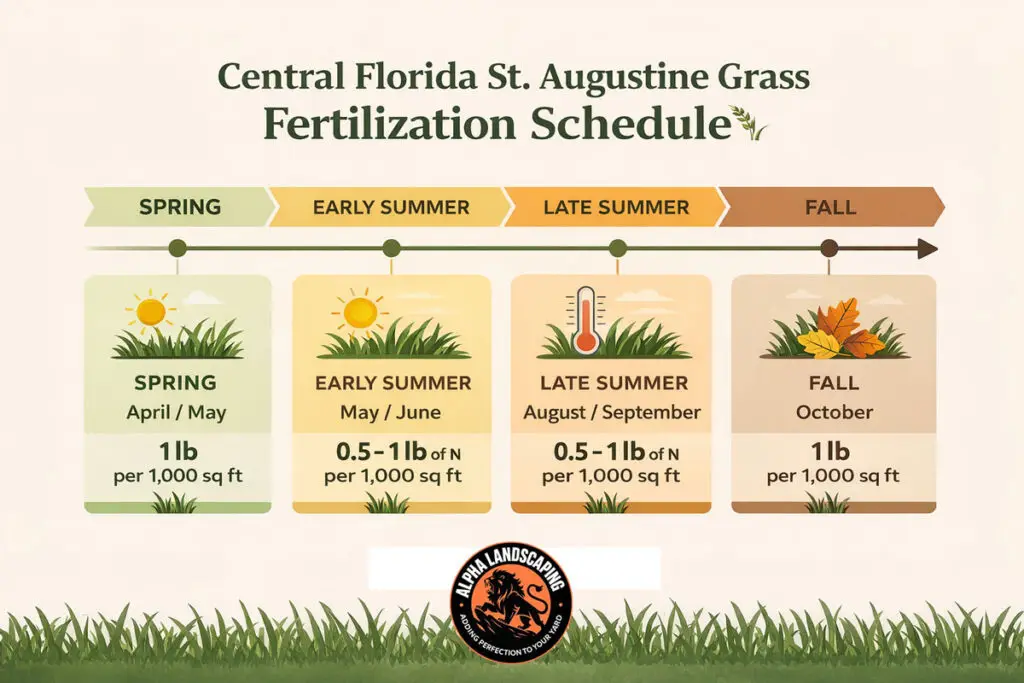
The best schedule begins in spring and follows the lawn through its active growing season. In much of Florida, this means feeding during spring and summer, then reducing or stopping nitrogen applications as cooler weather approaches. The exact start and end dates vary by location and local restrictions.
Use the table below as a planning guide, not as permission to fertilize on every listed date. Check the current University of Florida Institute of Food and Agricultural Sciences recommendations and your local county or city ordinance before each application. If a local rule prohibits fertilizer use during a particular period, the restriction takes priority over this general schedule.
Source: alphalandscapingllc.com
Spring green-up
Begin considering fertilizer after the lawn has resumed active growth and the danger of frost has passed. Do not feed grass that is still dormant or barely growing.
Late spring
If the lawn needs nutrients and local rules permit application, use an appropriate fertilizer at the recommended rate. Check the label and account for any nutrients already applied.
Early and midsummer
Continue only when the grass is actively growing, soil moisture is adequate, and the local fertilizer ordinance permits it. Avoid applying fertilizer immediately before heavy rain.
Late summer and early fall
Review the lawn’s color, growth, soil test, and regional weather. Apply more nitrogen only if it is appropriate and permitted, and leave enough time for growth to slow before cool weather.
Late fall and winter
Do not apply nitrogen simply to keep the lawn green. St. Augustine grass grows slowly or becomes dormant in cooler conditions, so unnecessary feeding can waste nutrients and increase runoff risk.
A Practical Month-by-Month Planning Table
Florida’s climate varies enough that the same month can mean different things in different parts of the state. Use these seasonal cues to plan ahead, then confirm the actual dates against local rules and current turfgrass guidance.
January and February
Usually avoid nitrogen fertilization while the lawn is dormant or growing slowly. Check for cold damage, drainage problems, and other causes of poor color before planning spring feeding.
March and April
Southern Florida may be growing actively earlier than northern Florida. Wait for sustained growth and suitable temperatures rather than fertilizing just because the calendar says spring.
May and June
These months often fall within the active growing season. Apply only if nutrient needs, the product label, weather, and local regulations support it.
July and August
Grass may grow quickly, but heavy rain and summer storms raise the risk of nutrient loss. Follow any seasonal fertilizer restrictions and avoid applications before downpours.
September and October
Conditions begin to cool earlier in northern Florida than in the south. Do not extend nitrogen feeding just to maintain a dark green color as growth slows.
November and December
Most lawns need little or no nitrogen during cool or dormant periods. Remove fallen leaves, mow when needed, and wait until the next active growing season to resume feeding.
Why Florida’s Region Changes the Schedule
Florida does not have one universal lawn-fertilizing date. South Florida usually has a longer warm growing season, while northern Florida can experience frost and winter dormancy for longer periods. Central Florida often falls between these patterns, but local weather can still shift the start and end of active growth.
Your lawn’s condition matters as much as its location. A healthy lawn that grows steadily may need less fertilizer than a thin lawn recovering from damage, but thin grass does not automatically need more nitrogen. Pests, disease, poor drainage, compacted soil, and incorrect mowing can all cause weak growth.
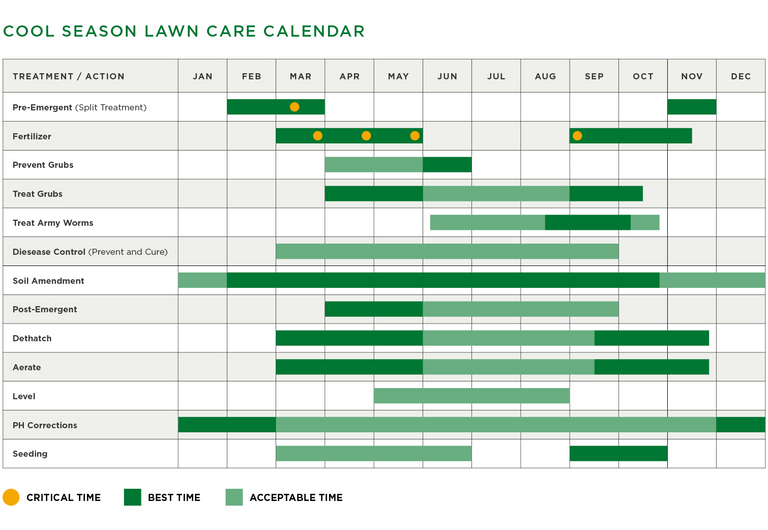
Source: gardencure.com
North Florida
Wait until frost risk has passed and the grass shows steady new growth. End nitrogen feeding earlier than in warmer southern areas if temperatures begin to fall and growth slows.
Central Florida
Use spring green-up and active growth to guide the first application. During summer, pay close attention to heavy rain and any local rainy-season restrictions.
South Florida
The growing season may last longer, but that does not mean fertilizer is needed every month. Follow local rules and avoid feeding grass that is stressed by flooding, drought, or disease.
Follow Grass Growth Instead of Guessing by Date
Look for fresh green blades, active runner growth, and a lawn that needs regular mowing. These signs suggest that St. Augustine grass has resumed growth. If the lawn remains brown after a cold spell, first check whether the crowns and runners are alive before applying fertilizer.
A warm afternoon does not always mean the lawn is ready for feeding. Soil may remain cold after a cool winter, and a short warm spell can be followed by another cold period. Waiting for steady growth helps reduce wasted fertilizer.
Signs that the lawn is ready
New leaf growth is visible, mowing needs are increasing, and the grass is not showing active drought or waterlogging stress.
Signs to wait
The lawn is dormant, the soil is saturated, frost is still possible, or the grass is wilting and unable to use nutrients well.
Choose the Right Fertilizer for St. Augustine Grass
A suitable lawn fertilizer supplies nutrients the grass needs without adding unnecessary phosphorus or excessive nitrogen. St. Augustine grass commonly benefits from nitrogen during active growth, but the correct product depends on the soil, previous applications, and the condition of the lawn.
Fertilizer labels list three numbers, such as 16-0-8. These numbers represent the percentage by weight of total nitrogen, available phosphate expressed as P2O5, and soluble potash expressed as K2O. A 16-0-8 product contains 16% nitrogen, no listed phosphate, and 8% potash by weight.
Do not assume that a product with a higher first number is always better. A concentrated fertilizer can supply the needed nitrogen at a lower product weight, but applying too much can burn the grass and waste nutrients. Follow the product label and local application limits.
Source: i.pinimg.com
Nitrogen
Supports leaf growth and green color. Excess nitrogen can encourage rapid growth, increase mowing needs, and make some lawn problems harder to manage.
Phosphorus
Supports root development and energy transfer, but established Florida lawns often do not need extra phosphorus unless soil testing or an applicable recommendation identifies a need. Local rules may restrict phosphorus use.
Potassium
Supports normal plant functions and stress response. Whether additional potassium is needed depends on soil conditions, the fertilizer already used, and current turfgrass recommendations.
Iron and other micronutrients
Can help correct specific nutrient deficiencies, but they are not substitutes for proper nitrogen management or correction of soil and water problems.
What Fertilizer Analysis Should You Look For?
Look for a lawn fertilizer whose nutrient analysis matches the needs of your grass and soil. Products with little or no phosphorus may suit established lawns that do not need additional phosphorus, but no single analysis is right for every Florida yard.
A slow-release nitrogen source can supply nutrients over a longer period than a rapidly available source. Check the label for the amount and type of slow-release nitrogen, the application rate, and any restrictions. Slow-release products still need to be applied correctly and may be subject to the same local fertilizer rules.
For established lawns
Choose a product suitable for St. Augustine grass and base nutrient selection on soil-test results and the current UF/IFAS recommendation.
For lawns with yellow leaves
Check whether the cause is nitrogen deficiency, iron chlorosis, excess water, disease, or another problem before choosing a fertilizer.
For new sod
Follow the sod supplier’s establishment guidance and current UF/IFAS recommendations. Rooting, irrigation, soil conditions, and local restrictions affect the correct timing.
How Much Fertilizer Should You Apply?
Calculate the amount of product from its nitrogen percentage and the recommended nitrogen rate per 1,000 square feet. Do not choose a rate simply because a bag says it is suitable for lawns. The current Florida turfgrass recommendation, the product label, and local ordinances determine what is appropriate.
A common way to compare fertilizer products is to calculate the weight of nitrogen they supply. For example, a hypothetical application of 0.5 pound of actual nitrogen per 1,000 square feet using a 16% nitrogen fertilizer would require about 3.1 pounds of product per 1,000 square feet. This is a math example, not a universal recommendation for every St. Augustine lawn.
Source: i.pinimg.com
Step 1: Measure the lawn
Estimate the area of each section in square feet. For a rectangular lawn, multiply length by width, then subtract large beds, patios, and other areas that will not receive fertilizer.
Step 2: Read the nitrogen percentage
Use the first number on the fertilizer analysis. Convert it to a decimal for the calculation, such as 16% becoming 0.16.
Step 3: Calculate product weight
Divide the target pounds of actual nitrogen by the nitrogen fraction on the label. Multiply the result by the lawn area divided by 1,000.
Step 4: Check all limits
Confirm the calculated amount does not exceed the label rate, local nitrogen limits, or the recommended amount for the grass and application interval.
A Simple Fertilizer Calculation Example
Suppose a lawn measures 4,000 square feet and a qualified recommendation calls for 0.5 pound of actual nitrogen per 1,000 square feet. The total nitrogen target would be 2 pounds. With a fertilizer containing 16% nitrogen, divide 2 by 0.16 to get 12.5 pounds of product for the whole lawn.
Before using this result, verify that the example rate is appropriate for your situation and permitted locally. A different fertilizer analysis changes the product weight, not the target amount of nitrogen. Never apply the example rate if the product label or local rules require less.
Formula
Pounds of fertilizer = desired pounds of actual nitrogen divided by the nitrogen fraction, multiplied by lawn area in square feet divided by 1,000.
Avoid double applications
Record the date, product, analysis, and amount each time you fertilize. This helps prevent overlapping applications from adding more nitrogen than intended.
Check Florida Fertilizer Rules Before Every Application
Florida homeowners should check county and city fertilizer ordinances before applying lawn fertilizer. Local rules can restrict nitrogen and phosphorus use during defined rainy-season periods, limit the amount applied, require fertilizer-free zones near water, or set conditions for application before rain. Requirements differ by location and can change over time.
Do not rely on a general statewide calendar or an online schedule that does not identify the county. A date that is permitted in one community may fall inside a restricted period in another. If you live in a community with an HOA, also check its lawn-care requirements, while remembering that an HOA rule does not replace local law.
Source: i.pinimg.com
Find the current local ordinance
Check your county government’s environmental, water-quality, or extension resources and your city’s official website if you live within city limits.
Check the rainy season
Some communities impose seasonal restrictions because heavy rain can carry fertilizer into stormwater systems and nearby waterways.
Keep fertilizer away from water
Follow all required setbacks and label directions near lakes, canals, ponds, wetlands, ditches, and storm drains.
Follow label directions
Use the product only for its labeled purpose and follow directions for application rates, irrigation, protective equipment, and storage.
Why Timing Matters for Florida’s Waterways
Florida receives intense rain during much of the warm season. If fertilizer is applied before a downpour, water may move nutrients away from the lawn before the grass can use them. Nitrogen and phosphorus entering water bodies can contribute to nutrient pollution and unwanted algae growth.
A careful schedule protects both the lawn and the surrounding environment. Apply only when conditions are suitable, sweep stray granules back onto the lawn where permitted, and never wash fertilizer into a street or storm drain. If the forecast calls for heavy rain, postpone the application.
Avoid saturated soil
Wait until the lawn can retain water and nutrients rather than shedding them across the surface.
Use the required water-free zone
Keep fertilizer out of prohibited areas beside water bodies and drainage features.
How to Apply Fertilizer Evenly and Safely
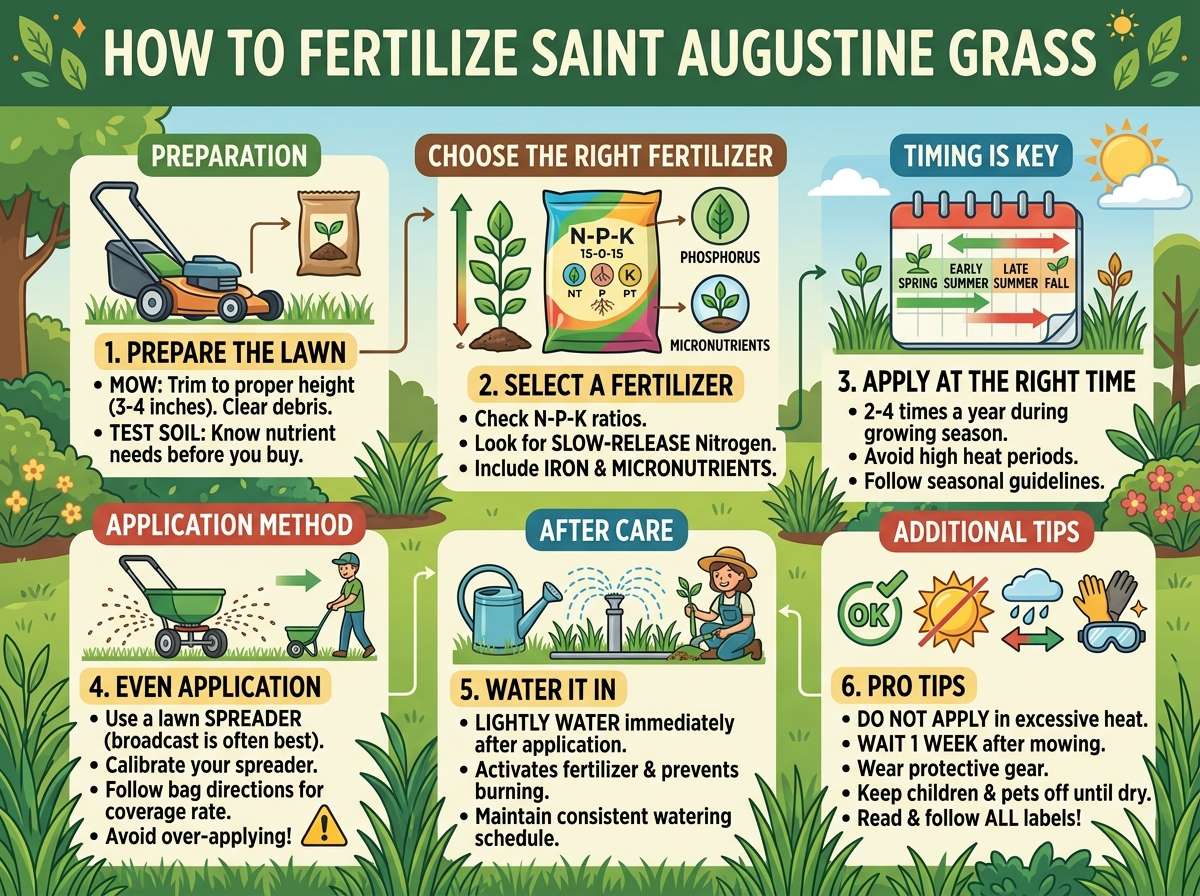
An even application helps prevent dark green stripes, pale patches, and fertilizer burn. A broadcast spreader works well for many lawns, while a drop spreader can offer more control near edges. Calibrate the spreader according to its instructions instead of assuming the same setting works for every fertilizer.
Fertilize when the grass is dry enough for granules to spread evenly, unless the product label specifies otherwise. Avoid windy conditions, standing water, and forecasts that call for heavy rain. Wear the protective equipment listed on the label, and keep children and pets away as directed.
Source: elitelandscapesga.com
Prepare the lawn
Mow if needed, remove loose debris, check the weather, and make sure irrigation or rainfall has not left the soil saturated.
Calibrate the spreader
Use the product’s stated setting as a starting point and confirm the spreader delivers the intended amount over a measured area.
Apply in a controlled pattern
Walk at a steady pace and follow the recommended overlap. Avoid dumping fertilizer in one spot or spreading it over pavement.
Clean up carefully
Sweep granules from sidewalks and driveways back onto the lawn if the label and local rules allow. Never hose them into a drain.
Water according to the label
Some granular fertilizers need irrigation to move nutrients off the leaf blades. Follow the product directions and avoid watering so heavily that runoff occurs.
What to Do After Fertilizing
Watch the lawn over the following days and weeks rather than applying more fertilizer when results are not immediate. The response depends on temperature, moisture, nutrient availability, and the type of fertilizer used. Slow-release products may produce a gradual change in growth and color.
If the grass develops brown or scorched patches soon after an application, suspect excessive fertilizer, uneven spreading, or granules left on wet foliage. Follow the product label’s instructions for corrective watering, provided the lawn can drain without runoff. If damage is severe or uncertain, contact your county Extension office for guidance.
Keep a lawn log
Record the product, analysis, application rate, date, weather, and irrigation. These notes make future decisions easier and help prevent accidental overfeeding.
Allow time for a response
Do not repeat the application early just because the lawn does not turn dark green within a day or two.
Adjust the Schedule for New Sod and Damaged Lawns
New sod and stressed lawns need a different approach from a healthy, established lawn. Fresh sod must form roots in the soil beneath it, so watering and root establishment come first. Applying extra fertilizer before the grass is ready can waste nutrients and may add stress.
For new St. Augustine sod, follow the supplier’s establishment directions and current UF/IFAS guidance. The right timing depends on whether the sod was placed over prepared soil, how well the roots are establishing, and what nutrients are available. Do not automatically use a high-nitrogen starter fertilizer without confirming that it is appropriate.
Source: cdn.shopify.com
New sod
Keep the sod and underlying soil moist according to establishment guidance, avoid runoff, and confirm rooting before changing to a routine feeding plan.
Drought-stressed grass
Restore suitable soil moisture first. Fertilizer cannot make severely wilted grass recover faster when it lacks water.
Flooded or waterlogged lawns
Correct drainage and wait until the grass and soil recover. Nutrients may be lost from saturated soil, but adding more fertilizer without checking conditions can worsen runoff.
Recently treated lawns
Check the label and the directions for any herbicide or pesticide already applied. Some products have timing restrictions for fertilizer or other lawn treatments.
Should You Fertilize a Brown St. Augustine Lawn?
Not until you know why it is brown. Cold injury, chinch bugs, gray leaf spot, take-all root rot, drought, poor drainage, and dull mower blades can all create symptoms that resemble a nutrient problem. More fertilizer may worsen some of these issues rather than fix them.
Inspect the lawn for patterns. Brown areas near pavement may indicate heat or drought stress, while irregular patches, damaged roots, or visible insects may point to other causes. If the cause remains unclear, take a sample or photographs to your county Extension office and request a diagnosis before applying more nutrients.
Check irrigation
Confirm that water reaches the affected areas and that the soil drains properly.
Inspect leaves and roots
Look for lesions, insects, damaged runners, and roots that are dark or poorly developed.
Test the soil when appropriate
Use a suitable soil test to help identify nutrient needs instead of guessing from color alone.
Common Fertilizer Schedule Mistakes to Avoid
The most common mistake is treating fertilizer as a cure for every lawn problem. St. Augustine grass needs suitable mowing, irrigation, drainage, and pest management as well as nutrients. A lawn that receives too much fertilizer may look lush for a short time but can develop excessive growth and need more frequent mowing.
A second mistake is copying a schedule from another state or even another part of Florida. Soil, weather, and local ordinances vary. Use general calendars to plan ahead, then make the actual decision based on current conditions and verified local guidance.
Source: houstonturfgrass.com
Fertilizing too early
Grass that has not resumed active growth cannot use nutrients as efficiently as actively growing grass.
Applying too much nitrogen
Excess nitrogen can encourage soft growth, increase mowing needs, and raise the chance of nutrient loss.
Adding phosphorus without a need
Extra phosphorus may be unnecessary for established lawns and can contribute to water pollution when it leaves the yard.
Fertilizing before heavy rain
Heavy rainfall can carry nutrients into drainage systems and nearby waterways before the grass uses them.
Feeding dormant grass
Winter applications made when St. Augustine grass is barely growing can be poorly timed and wasteful.
Ignoring mowing height
Cutting St. Augustine grass too short weakens the lawn and can expose soil. Follow the recommended mowing height for your cultivar and conditions.
How to Tell Whether Your Schedule Is Working
A suitable fertilizer program supports steady growth, an even canopy, and normal recovery from mowing. The lawn should not need repeated emergency feeding to maintain color. Compare its condition over several weeks and across the growing season rather than judging the program by a single day.
If the lawn remains pale despite correct applications, check irrigation, soil pH where relevant, drainage, and possible iron deficiency or disease. If growth becomes excessive or the lawn develops burn marks, review the product rate and spreader calibration. A soil test and a local Extension diagnosis can help separate nutrient problems from other causes.
Healthy response
Growth is steady, color is reasonably even, and the lawn recovers from routine mowing without excessive surges.
Possible overfertilization
Growth becomes unusually rapid, mowing needs rise sharply, or brown patches appear after an application.
Possible non-nutrient problem
Yellowing or thinning persists despite an appropriate application, or the lawn shows distinct patches, leaf lesions, pests, or poor drainage.
Frequently Asked Questions
Q
How often should I fertilize St. Augustine grass in Florida?
There is no single interval that fits every Florida lawn. Fertilize during active growth only as needed, following current UF/IFAS recommendations, the fertilizer label, soil conditions, and local ordinances. The right interval depends on the product’s nutrient release, the amount already applied, and the lawn’s response.
Q
What month should I first fertilize St. Augustine grass in Florida?
Many lawns can begin their seasonal feeding program in spring, but the correct month varies by region and weather. Wait until the grass has resumed steady growth and frost risk has passed. Check local fertilizer restrictions before applying anything.
Q
Can I fertilize St. Augustine grass during the Florida summer?
Summer can be part of the active growing season, but fertilizer use may be limited by local rainy-season rules. Even when application is allowed, avoid saturated soil and forecasts of heavy rain. Apply only the amount needed and permitted.
Q
Should I use a fertilizer with phosphorus on St. Augustine grass?
Not automatically. Established lawns often do not need extra phosphorus unless a soil test or an appropriate recommendation identifies a deficiency. Check your local ordinance because phosphorus applications may be restricted.
Q
Can I fertilize St. Augustine grass in winter?
Avoid routine nitrogen applications while the grass is dormant or growing slowly. Cold weather reduces nutrient demand, and fertilizer may be wasted if the grass cannot use it. Wait for active spring growth and check local rules before restarting.
Q
Why is my St. Augustine grass yellow after fertilizing?
Yellowing can result from fertilizer burn, iron deficiency, nitrogen deficiency, excess water, drought, disease, or pests. Check when the symptoms began, whether the spreader applied fertilizer evenly, and whether the soil drains well. Do not apply another dose until you have a reasonable idea of the cause.
Q
Is slow-release fertilizer better for St. Augustine grass?
Slow-release nitrogen can provide nutrients over a longer period and may reduce sudden growth surges compared with a rapidly available source. The best choice still depends on the label, application rate, soil needs, and local rules. Slow-release fertilizer is not permission to apply more nitrogen than recommended.
✦ Wrapping Up
Conclusion
A good fertilizer schedule for St. Augustine grass in Florida follows the lawn’s active growth, not a rigid set of monthly dates. Begin in spring when the grass greens up and grows steadily, continue only when nutrients are needed and local rules allow, and stop nitrogen feeding as cooler weather slows growth.
Use soil-test results to guide nutrient choices, measure the lawn before calculating the product amount, and follow both the fertilizer label and local ordinances. Avoid feeding stressed or dormant grass, keep granules away from pavement and waterways, and postpone applications before heavy rain. These habits help support a healthy lawn while reducing wasted fertilizer and nutrient runoff.
💡 Key Takeaway
Before your next application, identify your Florida county, check its current fertilizer ordinance, assess whether your St. Augustine grass is actively growing, and calculate the application rate from a suitable recommendation and the product label. If the lawn is yellow or thin for an unknown reason, diagnose the problem before adding more fertilizer.
I enjoy sharing simple gardening ideas, lawn care tips, and honest product reviews that help make outdoor work easier. From home gardening guides to helpful tools and lawn care advice, I write easy-to-follow content to help readers create a healthier and better-looking outdoor space without wasting time or money.