As an Amazon Associate, I earn from qualifying purchases.
Identify mint plants by checking their opposite leaves, square stems, strong minty scent, and small flowers. Crush a leaf gently to assess its aroma, then compare the leaf shape, texture, growth habit, and flowers with known mint varieties. Do not eat an unidentified plant based on scent alone.
Across the United States, mint grows in backyard herb gardens, raised beds, patio pots, and damp spots along fences. A plant that smells fresh and minty may look easy to identify, but several mint species and related plants share similar leaves and scents. A careful check of the whole plant is more useful than relying on one feature.
True mints belong to the genus Mentha in the mint family, Lamiaceae. Many have opposite leaves, stems with four distinct sides, and a strong scent when their leaves are rubbed. Peppermint, spearmint, apple mint, and wild mint can differ in leaf shape, surface texture, aroma, and growth pattern, although these traits can overlap.
This guide explains how to inspect a possible mint plant, compare common varieties, and avoid confusing mint with unrelated plants. It also covers wild plants, young seedlings, flowering stems, and plants that look like mint but may not be safe to eat. If you plan to use the leaves in food or tea, confirm the plant’s identity before harvesting.
A typical mint plant is a leafy perennial herb with branching stems, paired leaves, and a fresh scent. Many garden mints grow between about 1 and 3 feet tall, although height varies by species, growing conditions, and pruning. Some stay low and spread across the soil, while others grow upright.
The leaves usually grow in pairs on opposite sides of the stem. Each new pair often forms at a right angle to the pair below it, creating a balanced pattern along the stem. Leaf edges are commonly toothed, and the blades may be oval, lance-shaped, wrinkled, or slightly pointed.
Mint can look different as it matures. Young shoots may have small, soft leaves and green stems, while older plants may develop stronger branches, darker foliage, or reddish-purple stem tones. A plant should be checked at several stages when possible, rather than judged from one small leaf.
Source: thegardenfixes.com
Leaves
Usually appear in opposite pairs and often have toothed edges. Their size, shape, color, and surface texture depend on the species.
Stems
Often have four noticeable sides when viewed or felt gently between the fingers. Stems may be green, reddish, or purple-tinged.
Scent
Many true mints release a fresh, distinctive aroma when a leaf is gently rubbed. The scent can range from sweet and mild to sharp and cooling.
Flowers
Small flowers may grow in clusters or whorls along the stem or near the tip. Flower colors often include white, pink, lilac, and purple.
Why One Mint Plant May Look Different From Another
Mint appearance changes with sunlight, water, soil, and age. A plant growing in partial shade may develop larger, softer leaves than one growing in full sun. Regular harvesting can also create a shorter, bushier plant with many fresh shoots.
Hybridization adds another layer of variation. Peppermint, for example, is a hybrid mint, and cultivated plants may vary in leaf color, stem color, and growth habit. Use several identifying features together instead of expecting every plant of one variety to look exactly the same.
Check several stems
Compare mature leaves and new growth across the plant to see which traits remain consistent.
Look beyond color
Purple stems or dark leaves may support a comparison, but these features alone do not confirm a species.
How to Identify Mint Plants Step by Step
The most useful approach is to examine the plant from the stem outward, then check its scent and growth pattern. If it is flowering, include the flowers in your comparison. Do not rely on a single clue, especially if you intend to eat the leaves.
You do not need special tools for a first check. Good light, a magnifying glass if available, clean hands, and a trusted plant identification guide can help. If the plant is wild or its history is unknown, take photographs and leave it unharvested until its identity is confirmed.
Source: thegardenfixes.com
Step 1: Look at the leaf arrangement
Find a healthy stem and check whether the leaves grow in opposite pairs at each node. This is a useful mint-family clue, but other plant families also have opposite leaves.
Step 2: Inspect the stem
Look along the stem and gently feel it without breaking the plant. A four-sided stem supports identification as a member of the mint family.
Step 3: Check leaf shape and edges
Notice whether the leaves are broad or narrow, smooth or wrinkled, rounded or pointed. Look for small teeth around the edge.
Step 4: Assess the aroma
If safe to handle, rub a small leaf gently between your fingers and smell it. A minty scent supports the identification but does not establish that the plant is edible.
Step 5: Examine the growth pattern
Look for multiple stems emerging from a spreading patch, underground rhizomes, or runners. Avoid digging up an unknown plant just to check its roots.
Step 6: Check for flowers
When present, photograph the flowers and note their color, shape, and position. These features can help narrow the identification.
Step 7: Compare all observations
Match the plant’s combined traits with a reputable botanical reference or a local extension service. If key traits disagree, keep the identification uncertain.
How to Inspect a Mint Stem
A square stem is one of the best quick clues for a plant in the mint family. Look at a section between two leaf pairs and rotate it in the light. Four ridges or flat sides may be visible, although young stems can be difficult to assess.
Do not treat a square stem as proof of mint. Several unrelated plants have stems with similar shapes, and some mint-family plants are not culinary herbs. Stem shape becomes more useful when it agrees with the leaf arrangement, scent, and flowers.
Best place to check
Examine a mature, healthy section of stem rather than a soft new shoot or a woody base.
What to avoid
Do not chew a stem or taste a leaf as an identification test.
How to Use Scent Without Taking Risks
Scent can help distinguish common mint varieties. Spearmint often smells sweet and fresh, while peppermint tends to have a sharper, cooling aroma. Apple mint may have a softer, fruity scent, but growing conditions and individual plants can change how strong these smells seem.
Only smell a plant after confirming that it is safe to handle. Do not crush unknown plants that may cause skin irritation, and wash your hands afterward. A familiar scent is a clue, not a safety test.
Use a small leaf
Gently rub one leaf instead of crushing a large handful of foliage.
Record the result
Describe the aroma as sweet, sharp, cooling, fruity, or weak, then compare it with the plant’s other features.
How to Tell Common Mint Varieties Apart
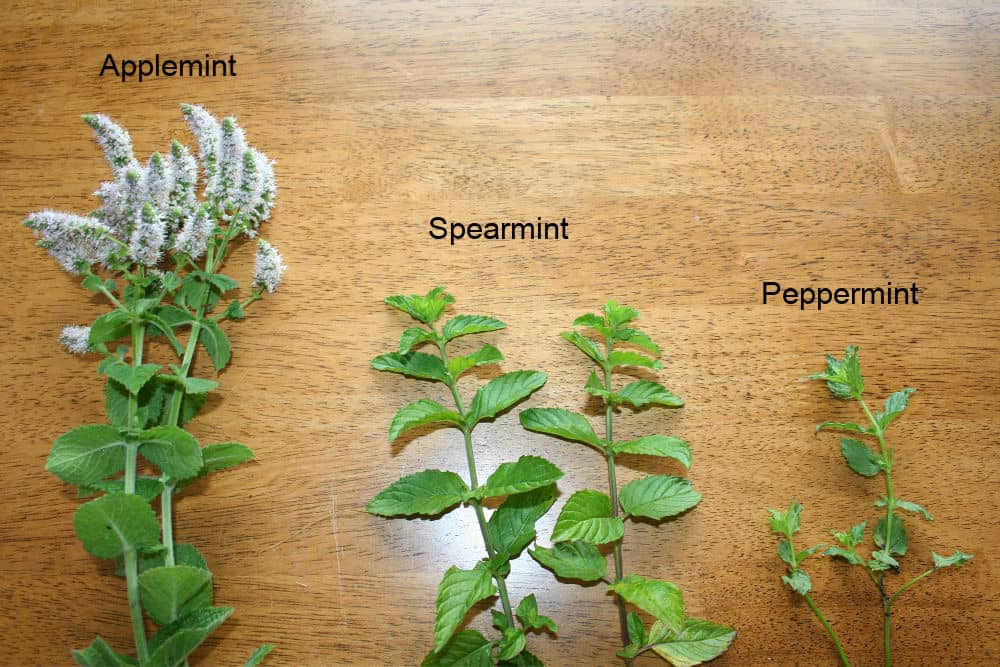
Peppermint, spearmint, and apple mint are common garden choices in the United States. They share several traits because they belong to the same genus, so their differences are usually a matter of degree rather than one perfect identifying mark. Compare several mature leaves and, when available, the flowers.
Labels on nursery pots are helpful when the plant comes from a reliable grower, but labels can be lost or mixed up in a shared garden. If you inherited a patch or found it growing outdoors, use the plant’s visible traits to narrow the options and confirm the result with a botanical reference.
Source: homegardenjoy.com
Peppermint
Mentha × piperita often has relatively narrow, pointed leaves, a strong cooling scent, and stems that may show reddish or purple tones. Leaf color and stem color vary, so neither feature is decisive.
Spearmint
Mentha spicata often has bright to medium green leaves with pointed tips and a sweet, familiar mint aroma. Leaves are commonly less dark than those of some peppermint plants.
Apple mint
Mentha suaveolens often has rounded or oval leaves with a soft, wrinkled, or hairy surface. Its foliage can feel more velvety than that of many other garden mints.
Pennyroyal
Mentha pulegium is a mint relative with small leaves and a low growth habit. It contains pulegone and can cause serious poisoning, particularly when concentrated oil is swallowed. Do not use pennyroyal as a culinary substitute.
Peppermint vs. Spearmint
The easiest way to compare peppermint and spearmint is to consider leaf shape, scent, and overall growth together. Peppermint commonly has a more intense cooling aroma, while spearmint often smells sweeter and less sharp. These are general patterns, not definitive tests.
Peppermint is a hybrid, and its plants may not produce viable seed in the same way as many other mints. Spearmint also varies among cultivated forms. If the distinction matters for cooking or plant labeling, use a known nursery plant or confirm the identification with a reliable botanical source.
Leaf appearance
Peppermint often has narrower leaves, while spearmint commonly has somewhat broader, pointed leaves. Overlap is possible.
Aroma
Peppermint often smells sharp and cooling. Spearmint usually has a sweeter, softer scent.
Stem color
Some peppermint plants have reddish-purple stems, but stem color alone cannot confirm peppermint.
Recognizing Apple Mint
Apple mint often stands out because its leaves look and feel softer than those of many other mints. The leaves are frequently broad, rounded, and covered in fine hairs, giving the surface a slightly fuzzy appearance. Its scent may seem fruity or mild compared with peppermint.
Variegated apple mint cultivars can have pale or creamy markings on the leaves. These patterns are useful when present, but not all apple mint plants are variegated. Check the leaf surface, arrangement, and stem shape before drawing a conclusion.
Texture
Look for fine hairs and a softly wrinkled surface.
Leaf shape
Leaves are often broader and more rounded than the narrow leaves found on some peppermint plants.
Mint Leaves: Shape, Color, and Texture
Mint leaves provide several clues, but leaf shape varies across species and cultivars. Most true mints have simple leaves attached in opposite pairs, with edges that are toothed or serrated. The tip may be pointed, and the surface can be smooth, puckered, or hairy.
Color is less reliable than arrangement and texture. Leaves may range from light green to deep green, and some plants develop purple or reddish tones in response to genetics or growing conditions. Yellowing, pale leaves, or dark spots can also signal stress or disease rather than a different mint species.
To compare leaves, examine several mature examples from the middle of the plant. Look at the top and underside, note the size and shape, and take a clear photograph beside a ruler if you need to compare dimensions. Avoid removing lots of leaves from a plant you do not own or cannot safely handle.
Source: images.farmfoodfamily.com
Oval leaves
Common on several mints, including apple mint, but an oval leaf alone does not establish the species.
Pointed leaves
Frequently seen on peppermint and spearmint, with differences in width and length between plants.
Toothed margins
Small teeth along the leaf edge are common in Mentha and can help when combined with other traits.
Hairy or wrinkled leaves
May support an apple mint identification, especially when the leaves are broad and rounded.
Do All Mint Plants Have Green Leaves?
No. Green is common, but some mint varieties have purple-tinged stems, darker leaves, or cream-colored leaf markings. These differences can reflect the variety or growing conditions rather than a separate species.
If a plant has unusual leaf colors, check whether the pattern is consistent across new growth. Sudden yellowing, spotting, or wilting may point to water stress, poor drainage, pests, or disease. Color should support an identification, not replace the other checks.
Normal variation
Evenly patterned variegation or consistent purple tones may be part of a cultivar’s appearance.
Possible plant stress
Sudden discoloration, limp growth, or spreading spots call for a plant-health check rather than a species guess.
How Mint Grows and Spreads
Many mints spread through underground stems called rhizomes and through runners that grow along the soil surface. New shoots can appear a short distance from the original plant, creating a patch of stems that may seem to be several separate plants. This spreading habit is common in established garden mint.
A dense patch can help distinguish mature mint from a single upright seedling, but it does not prove the identity. Other herbs and weeds can also form colonies. Check the leaf arrangement, stem shape, aroma, and flowers before deciding that a spreading plant is mint.
In home gardens, mint often thrives in moist soil and partial shade, although many varieties tolerate full sun when water is available. It may spread rapidly in fertile beds with regular moisture. Gardeners often grow it in containers to keep the roots from invading nearby beds.
Source: i.pinimg.com
Underground rhizomes
Horizontal stems below the soil can produce new roots and shoots, allowing a mint patch to expand.
Surface runners
Some stems spread along the ground and root at points where they touch moist soil.
Dense growth
Established plants may form clusters of upright stems, particularly where moisture and growing space are plentiful.
How to Tell Mint From a Young Weed
Young mint can be difficult to recognize because its first leaves may be smaller and less textured than mature leaves. Wait for several sets of true leaves, which develop after the initial seed leaves, before attempting a closer comparison. Opposite leaf pairs and a square stem can become easier to see as the plant grows.
Do not pull or eat an unknown seedling just because it appears in a mint bed. Seeds, roots, and runners from nearby plants can become mixed together. Photograph the seedling and compare it with a trusted field guide or ask a local extension office for help.
Check new growth
Look for repeated opposite leaf pairs on a developing stem.
Wait for more evidence
Allow the plant to develop mature leaves or flowers if it is safe to leave it in place.
Mint Flowers and Their Role in Identification
Mint flowers offer useful clues once a plant begins to bloom. They are usually small and may appear in dense clusters, rounded groups, or whorls around the stem. Depending on the species and cultivar, flowers may be white, pale pink, lilac, or purple.
Flower position and shape can help narrow the possibilities, especially when leaf and stem traits already point toward Mentha. However, several other members of the mint family produce similar small flowers. A flower color by itself is not enough to confirm the plant.
Mint flowering time varies with species, climate, planting date, and local weather. In many parts of the United States, garden mints flower during the warmer months, but timing differs by region. A plant that has not flowered is not necessarily a different species; it may be young or recently trimmed.
Source: i.pinimg.com
Flower color
White, pink, lilac, and purple shades occur among common mints.
Flower placement
Flowers may cluster near stem tips or form rings at points along the stem.
Timing
Blooming depends on the plant and local conditions, so flowering dates are supporting evidence rather than a fixed rule.
Should You Wait for Mint to Flower?
If you cannot identify a plant from its leaves and stems, flowers may provide the extra detail you need. Take photographs of the whole plant, a close view of a mature leaf, and the flower cluster. These images can be more useful than a single picture of the foliage.
Do not wait for flowers if the plant is spreading into a sensitive area or may be an invasive weed. Seek local guidance before removing an unknown plant, especially in natural areas where similar species may have conservation value.
Photograph the whole stem
Include the leaves and the location of the flower cluster in one clear image.
Record the habitat
Note whether the plant grows in a wet ditch, woodland edge, garden bed, container, or sunny field.
Plants That Can Be Mistaken for Mint
Not every plant with a minty smell or square stem is an edible mint. Several plants in the mint family resemble culinary herbs, and unrelated plants can share some of their visible traits. This is why safe identification depends on the complete plant rather than a quick look.
Pennyroyal is particularly important to recognize because it belongs to Mentha but is not a safe substitute for culinary peppermint or spearmint. Pennyroyal oil contains pulegone, a substance associated with severe liver injury and other serious effects. Never swallow pennyroyal oil or use it as a home remedy.
Other plants, including catnip, lemon balm, and some wild mints, may resemble common garden mint. These plants can have different aromas, leaf shapes, and growth habits. A plant’s use by cats, its lemon-like smell, or its location near a garden does not establish that it is a particular mint species.
Source: i.pinimg.com
Catnip
Nepeta cataria belongs to the mint family and often has gray-green, softly hairy leaves. Its scent and leaf texture differ from many culinary mints.
Lemon balm
Melissa officinalis has opposite, toothed leaves and a lemon-like aroma when rubbed. Its scent can help distinguish it from peppermint, but confirm the plant with other traits.
Pennyroyal
Mentha pulegium has small leaves and may grow low to the ground. Do not consume it or its concentrated oil.
Other mint-family herbs
Plants such as basil, oregano, and many ornamental salvias share family traits but have different combinations of leaf, stem, and flower features.
Why a Minty Smell Is Not Enough
Aroma comes from plant chemicals that can occur in more than one species. Some unrelated plants also smell fresh, camphor-like, or minty. Even a familiar peppermint-like scent cannot prove that a plant is safe to eat.
For a plant intended for food, confirm the scientific name or obtain a correctly labeled specimen from a reputable nursery. For wild plants, consult a qualified local botanist, extension service, or experienced plant identification specialist. If the identity remains uncertain, do not harvest it.
Do not taste-test
Never chew an unknown leaf to check whether it tastes like mint.
Do not rely on an app alone
Photo identification tools can suggest possible species, but similar plants may produce incorrect matches.
Seek confirmation
Use a regional botanical key or a qualified local source when the plant will be eaten or used medicinally.
How to Identify Wild Mint in the United States
Wild mint can grow near streams, marshes, wet meadows, drainage areas, and other moist places, depending on the species. Some wild mints also occur in disturbed ground or open areas. Habitat can help narrow the choices, but it is not a reliable identification by itself.
Several Mentha species occur in North America, and common names vary by region. A plant called wild mint in one reference may not be the same plant a neighbor uses that name for. When identification matters, record the scientific name and compare the plant with a regional flora or state university extension resource.
When examining a wild plant, avoid collecting from roadsides, polluted drainage channels, treated lawns, or land where harvesting is not allowed. Plants growing near roads or runoff areas may have been exposed to contaminants. Permission and clean growing conditions matter as much as identification.
Source: i.pinimg.com
Observe the habitat
Record soil moisture, sunlight, nearby vegetation, and whether the plant grows alone or in a patch.
Photograph key features
Capture the leaf arrangement, stem, leaf underside, flowers, and whole-plant shape.
Use regional references
Compare the plant with a state or regional botanical guide because species distribution differs across the country.
Leave uncertain plants alone
Do not harvest for tea, food, or medicine until the identification has been confirmed.
Can You Identify Wild Mint Without Flowers?
Sometimes, but confidence may be lower. Leaf arrangement, stem shape, surface texture, scent, and growth habit can narrow the options even when a plant is not blooming. Some species require closer examination of flower structures or other botanical details to distinguish them.
If two possible species look alike, do not force a conclusion. Take photographs over time and ask a local extension service or botanical group for help. A cautious identification is more useful than a confident guess.
Useful without flowers
Opposite leaves, a four-sided stem, leaf texture, and growth habit can support an initial identification.
Limits
Closely related species and hybrids may not be distinguishable from casual photographs alone.
Common Mint Identification Mistakes
The most common mistake is deciding that a plant is mint because one leaf looks familiar. Young plants, stressed plants, and related herbs can all look different from the pictures people remember. A reliable identification combines several features and accounts for natural variation.
Another mistake is assuming that every mint-family plant is suitable for cooking. The mint family contains many genera, and not all plants have the same uses or safety profile. Even within Mentha, pennyroyal should not be treated as a culinary mint.
Gardeners can also misidentify a plant by relying too heavily on stem color, leaf size, or smell. These features can change with the variety and growing conditions. If one trait seems unusual, check the rest of the plant before deciding whether it is a different species.
Source: homegardenjoy.com
Mistake: Using scent as the only test
Correction: Combine scent with leaf arrangement, stem shape, texture, flowers, and a reliable reference.
Mistake: Assuming purple stems mean peppermint
Correction: Treat stem color as a supporting clue because several plants may develop reddish or purple tones.
Mistake: Trusting a photo match without checking
Correction: Compare multiple plant features and verify the suggested species with a trusted source.
Mistake: Eating a plant because it grows beside known mint
Correction: Identify each plant separately. Mixed beds can contain weeds, seedlings, and unrelated herbs.
Mistake: Ignoring plant stress
Correction: Distinguish natural species traits from yellowing, spots, wilting, and other signs of poor plant health.
What to Do When the Features Do Not Match
When a plant has opposite leaves but no clear mint scent, or a minty scent but an unusual leaf pattern, keep the identification open. It may be another mint-family species, a hybrid, or an unrelated plant with similar features. Do not choose the closest-looking species simply to complete the identification.
Take clear photographs of the whole plant and its key structures. Note where it grows, whether it is cultivated or wild, and whether it has flowers. Share this information with a local extension office or botanical specialist and wait for confirmation before eating or using the plant.
Record observations
Write down leaf arrangement, edge shape, stem form, aroma, flowers, height, and habitat.
Keep the plant separate
If it is in a herb garden, avoid harvesting it with confirmed culinary herbs until the identity is clear.
A Practical Mint Identification Checklist
A short checklist helps organize the clues you observe. It is a screening tool, not a botanical key, and it cannot prove that a plant is safe to eat. Use it to decide whether the plant resembles Mentha and whether you need help with a closer identification.
Check a mature stem when possible, and compare more than one leaf. If the plant has flowers, include their color and position in your notes. A clear record makes it easier to compare the plant with a reliable reference or ask someone qualified to identify it.
Source: images.farmfoodfamily.com
Leaf arrangement
Leaves appear in opposite pairs along the stem.
Stem shape
The stem has four sides or clear ridges.
Leaf edges
The edges show small teeth, although their size and prominence vary.
Leaf surface
The texture is consistent with the suspected variety, such as the soft hairs often seen on apple mint.
Aroma
A fresh mint-like scent is present, but it is treated as one clue rather than proof.
Growth habit
The plant may form a spreading patch through rhizomes or runners.
Flowers
Flower shape, color, and position agree with the suspected species when flowers are available.
Reference check
The combined traits match a trusted botanical guide or a confirmed nursery specimen.
How to Record Your Findings
Start with the plant’s location and growth habit, then record the shape and arrangement of its leaves. Add a stem photograph and a close view of the leaf surface. If it is flowering, photograph the flowers from the side and above.
Compare the notes with a botanical source that covers your region. If the source lists several possible species, check the traits that separate them rather than selecting a name based on overall resemblance. When the plant is intended for food, seek a confirmed identification.
Best photographs
Take one image of the whole plant, one of the stem and leaf pairs, one of a mature leaf, and one of the flowers if present.
Best next step
Use the images and observations to consult a regional field guide, university extension office, or qualified botanist.
Frequently Asked Questions
Q
What is the easiest way to identify a mint plant?
Start with the opposite leaf pairs and check whether the stem has four sides. Look for toothed leaves, assess the aroma only if the plant is safe to handle, and note the growth habit. Confirm the plant by comparing several features with a reliable botanical reference.
Q
Can I identify mint by its smell alone?
No. A minty aroma is a useful clue, but other plants can have similar scents. Some plants in the mint family are not suitable for eating, and pennyroyal can be dangerous. Never taste an unknown plant or use smell alone to decide whether it is safe.
Q
How can I tell peppermint from spearmint?
Peppermint often has a sharper, cooling scent and relatively narrow leaves, while spearmint commonly has a sweeter aroma and broader green leaves. These traits overlap, and stem color is not decisive. Check the whole plant and confirm the variety through a trusted source.
Q
Do all mint plants have square stems?
Four-sided stems are common in the mint family, including Mentha, but they are not unique to mint. Other plants may also have square stems, and young shoots can be hard to assess. Use stem shape with leaf arrangement, scent, and other features.
Q
Can wild mint be eaten after I identify it?
Only consider eating a wild plant after its identity has been reliably confirmed and the collection site is suitable. Avoid plants from polluted runoff, treated areas, or places where harvesting is prohibited. Do not eat an uncertain specimen, even if it smells like familiar garden mint.
Q
What plant looks like mint but is not culinary mint?
Catnip, lemon balm, and other mint-family plants can resemble culinary mint. Pennyroyal is especially important to distinguish because it can cause serious poisoning, particularly as an essential oil. Compare leaf texture, aroma, stem features, and flowers, and obtain confirmation before use.
Q
Can a mint plant be identified without flowers?
Often, you can narrow the possibilities by checking the leaves, stem, scent, and growth habit. However, some closely related species need flower details for a reliable distinction. If the plant will be used for food or medicine, do not rely on a tentative identification.
✦ Wrapping Up
Conclusion
The best way to identify mint plants is to examine several features together. Opposite leaf pairs, a four-sided stem, toothed leaves, a minty aroma, and a spreading growth habit can all support the identification. Flowers and leaf texture may help you tell peppermint, spearmint, apple mint, and other related plants apart.
Keep in mind that plants vary with age, climate, and growing conditions. A photo match or familiar smell is not enough to establish the identity of a wild plant. Pennyroyal and other lookalikes also show why identification and safe use must remain separate decisions.
💡 Key Takeaway
Photograph the whole plant, a mature leaf, the stem, and any flowers. Compare the features with a trusted regional botanical guide or ask a local extension service for help. Do not eat or use the plant until its identity has been confirmed.
I enjoy sharing simple gardening ideas, lawn care tips, and honest product reviews that help make outdoor work easier. From home gardening guides to helpful tools and lawn care advice, I write easy-to-follow content to help readers create a healthier and better-looking outdoor space without wasting time or money.